The Dissolution of the Financial State by Mouatt Simon
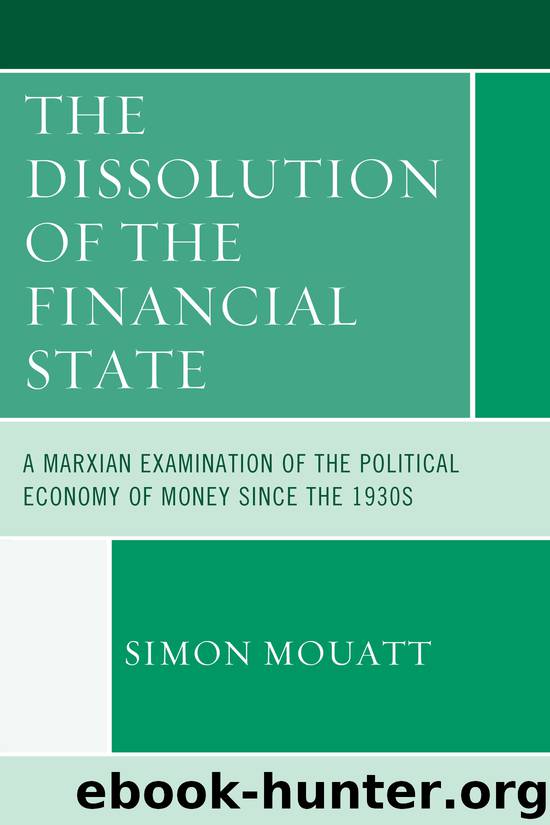
Author:Mouatt, Simon.
Language: eng
Format: epub
Publisher: Lexington Books, a division of Rowman & Littlefield Publishers, Inc.
7.5 THE FINANCIAL STATE
The state has clearly discharged different functions in the monetary system depending on historic context and place. Karl Polanyi, for example, pointed out that power has ebbed and flowed between state and market, depending on the historical epoch in question (Polanyi 1944). The aim in this section, however, is to illustrate the financial control that is actually discharged by the modern capitalist state, as determined by professional, academic and informed popular sources as a prelude to the empirical chapters. Clearly, as Knapp had noted in a 1905 seminal work, the authorities are responsible for the sanctioning of the currency by law, which, in turn, finds its legitimacy in its acceptability for the payment of state taxes (Knapp 1924). Yet, the common fallacy that suggests it is the government that solely issues the currency is simply not true. So, if this is the case, what does the banking, and educational literature, say on the matter?
It was noted in chapter 3 that monetary theory, in the history of economics, has provided exogenous and endogenous views of money-issue and also provided varying explanations of other monetary processes. Yet, in reality, it is the combination of the state, including the national bank as a semi-state agency in conjunction with the private banking infrastructure that is responsible for the money-issue. One of the common difficulties is that the economics literature (e.g., Pilbeam) still persists in presenting the credit multiplier as a demonstration of private bank credit-money expansion, which necessarily depends upon the existence of a state-determined reserve asset ratio (Pilbeam 2005). Yet, as Rochon has pointed out, this ratio has disappeared in a few western nation-states including the UK, and is minimal in others. This continued inaccuracy gives the impression that the state is still able to fully determine the overall level of credit-money expansion. There is a pressing need, therefore, for the textbooks to be rewritten (Rochon 2007). A notable exception is the Howells and Bain textbook. Here, there is an explanation, primarily for undergraduates, of the EMT with reference to double-entry bookkeeping. This is termed the flow of funds model, since money units are created in response to demand. The authors also note that the unreality of the alternative monetary-base multiplier model still persists in many textbook explanations (Howells 2002). However, since the state or central bank sets the short-term base interest rate in an exogenous sense, it could still be argued that they are still responsible for the overall level of monies created. Yet, this is ineffectual since they are not able to have accurate knowledge of the likely credit-consumer behavior and, therefore, no reliable indicator of the overall volume of credit money that will be established. The flow of funds model recognizes that money comes into being as a result of loans, and establishes a corresponding liability and asset on the balance sheet. The deposit, once created, becomes a bank liability, and the loan itself is an asset, since the principal plus interest needs to be repaid to the bank.
Download
This site does not store any files on its server. We only index and link to content provided by other sites. Please contact the content providers to delete copyright contents if any and email us, we'll remove relevant links or contents immediately.
International Integration of the Brazilian Economy by Elias C. Grivoyannis(111103)
The Radium Girls by Kate Moore(12045)
Turbulence by E. J. Noyes(8062)
Nudge - Improving Decisions about Health, Wealth, and Happiness by Thaler Sunstein(7717)
The Black Swan by Nassim Nicholas Taleb(7146)
Rich Dad Poor Dad by Robert T. Kiyosaki(6655)
Pioneering Portfolio Management by David F. Swensen(6312)
Man-made Catastrophes and Risk Information Concealment by Dmitry Chernov & Didier Sornette(6049)
Zero to One by Peter Thiel(5818)
Secrecy World by Jake Bernstein(4764)
Millionaire: The Philanderer, Gambler, and Duelist Who Invented Modern Finance by Janet Gleeson(4492)
The Age of Surveillance Capitalism by Shoshana Zuboff(4315)
Skin in the Game by Nassim Nicholas Taleb(4265)
The Money Culture by Michael Lewis(4218)
Bullshit Jobs by David Graeber(4204)
Skin in the Game: Hidden Asymmetries in Daily Life by Nassim Nicholas Taleb(4021)
The Dhandho Investor by Mohnish Pabrai(3780)
The Wisdom of Finance by Mihir Desai(3757)
Blockchain Basics by Daniel Drescher(3592)
